For many individuals, securing a Police Clearance Certificate (PCC) with an apostille is a crucial step for immigration, employment or other legal purposes in South Africa. Immigration authorities or embassies often require a Police Clearance Certificate certified with an apostille for background checks. The SAPS police clearance certificate is therefore indispensable, as it proves that the holder has not been involved in any criminal activity. It assures the host country that the certificate holder is not wanted by South African law enforcement agencies, is of good character, and has a clean criminal record.
This article aims to provide a comprehensive guide to securing your SAPS police certificate with apostille, detailing the necessary steps and requirements and answering frequently asked questions. It will also describe how Global Apostille can provide expedited services to meet your needs.
Understanding the SAPS Police Certificate
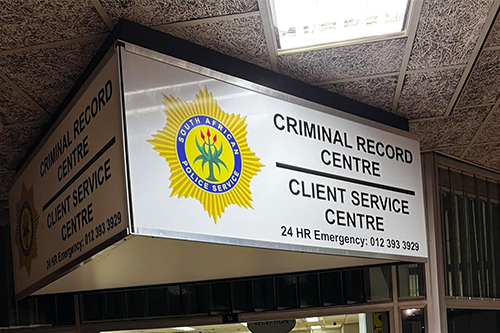
As the name suggests, the SAPS Police Certificate is an official document issued by the South African Police Criminal Record Centre (CRC) that attests to an individual’s good behaviour and lack of a criminal record, or provides a summary of their criminal history in South Africa.
The certificate is generally valid for six months from the date of issue. Both current South Africa residents and former residents who have already left the country can apply. For applicants living abroad, the certificate can be arranged through a representative in South Africa or through the nearest South African Embassy or Consulate, which forwards the request to the South African Criminal Record Centre (CRC).
Who Needs a SAPS Police Clearance Certificate?
You will need a SAPS PCC if you are enrolling in a university abroad, applying for a long-term residency visa, seeking employment overseas or in a regulated sector in South Africa such as healthcare, finance, or education, or if you are applying for immigration to Spain, Netherlands UAE, Australia, the UK, Germany, or any other country,
Step-by-Step Application Process
For Applicants Living in South Africa
Identify your local police station based on your residential address.
Obtain and complete the relevant application form and provide a full set of fingerprints from both hands on a SAPS 91(a) fingerprint form, taken by a police officer.
Pay the R190 application fee.
Attach a certified copy of your ID or passport.
The local police will forward your request to the South African Criminal Record Centre (CRC). Once your application has been processed, your certificate will be issued within two to four weeks.
Collect your certificate in person or via courier, depending on the system in your province.
For Applicants Living Abroad
Contact the nearest South African Embassy or Consulate to understand their specific procedure
Obtain and complete the relevant application form, providing full sets of fingerprints from both hands on a SAPS 91(a) fingerprint form. This can be done at a local police station, fingerprinting agency, authorised notary or Consulate. Pay the R190 application fee and attach a certified copy of your ID or passport. You then have two options:
Leave all documents at the South African embassy or consulate, which will forward the request to the CRC. Once cleared, the certificate will be issued within three to six months and returned to you by courier or through the Embassy.
Collect all your documents and send them to a representative in South Africa, who will apply for your certificate on your behalf at the South African Criminal Record Centre (CRC). Once cleared, the certificate will be issued within two to four weeks.
If required, get it attested by the Department of International Relations and Cooperation (DIRCO) for official use abroad.
Why the Apostille Process Matters for Police Clearance Certificates
Police Clearance Certificates are only valid within South Africa. To make them legally recognised abroad, an apostille is often required.
Apostilles are international certificates issued by the Department of International Relations and Cooperation (DIRCO). It is attached to your Police Clearance Certificate and verifies that the document is genuine. However, it does not verify the information contained within the certificate; it only confirms that the signature, seal, or stamp is genuine.
This certification is provided under the 1961 Hague Apostille Convention. Member countries of the Convention accept an apostille as valid proof, meaning no additional embassy or consular legalisation is required.
How Global Apostille Can Help
With over 10 years’ experience in providing services such as obtaining police clearance and apostille certificates in Johannesburg, Pretoria Durban and Cape town, Global Apostille offers clients a seamless, hassle-free experience. Here’s how we can assist:
Fast and Efficient Service: We understand how urgent your document application and legalisation are. Our team is dedicated to providing a prompt and efficient apostille service to ensure your South African Police Service (SAPS) police certificate is issued and apostilled.
Expertise and Experience: Our team has years of experience in PCC applications and legalisation, and possesses the necessary expertise and knowledge to navigate the intricacies of the process. We are familiar with the specific requirements for obtaining Police Clearance Certificates and can guide you through the process with ease.
Global Reach: Global Apostille caters to clients from all corners of the globe, whether you’re located in South Africa or abroad. Once the process is complete, we will send the finalised documents to you via a secure courier service, primarily DHL or Courier Guy (SA), no matter where you are.
No need to deal with confusing paperwork, long lines, or hidden fees. Let us take care of your PCC and apostille—quickly, securely, and professionally.
Tel: 012 348 3134; Mobile: 081 347 6060; Email: info@apostillelegalisation.co.za