
Affidavit Urgent Apostille Service
An affidavit is a written statement that is sworn or affirmed before a notary public or commissioner of oaths and declares certain facts to be true. Affidavits are commonly required for personal, business or legal matters with an international element. You may need to have an affidavit legalised for:
- International legal cases
- Overseas property transactions
- Immigration applications
If you intend to use an affidavit outside South Africa, you may need to obtain a notarisation and High Court apostille of the document.

At Global Apostille, our professional team can assist you with the notarisation and High Court apostille of your affidavit to ensure its authenticity and legal compliance in Pretoria, Johannesburg, Cape Town and Durban.
Get your Affidavit Urgent Apostille Service in as little as 1 to 3 working days.
The Role of Notary Publics in Affidavit Notarisation and High Court Apostille
Notarisation is a critical step in the High Court Apostille process. In Pretoria, a Notary Public is a qualified legal professional authorised to certify signatures, witness declarations and verify the authenticity of affidavits. This certification is essential for documents that will be used internationally, as it confirms that the affidavit was properly executed under South African law.
Notarisation ensures that foreign courts, embassies and authorities can accept the affidavit without question, safeguarding against fraud and providing legal certainty. Once notarised, the affidavit can be submitted to the High Court for apostille certification.
Notarisation and High Court Apostille Process for Affidavits
The High Court Apostille process for affidavits involves the following steps:
- Document Notarisation: The affidavit must first be signed before a Notary Public, who verifies the identity of the declarant and ensures the declaration is properly executed.
- Certified Copy Preparation: A certified copy of the notarised affidavit is prepared for submission to the High Court. Original documents are not required for High Court Apostille; the certified copy is sufficient.
- High Court Apostille Issuance: The certified copy is submitted to the High Court in Pretoria, where an Apostille certificate is affixed. This certifies the authenticity of the Notary Public’s signature and seal, making the affidavit legally recognised in countries that are parties to the 1961 Hague Apostille Convention.
It is important to note that the High Court Apostille does not verify the content of the affidavit itself but certifies the authenticity of its notarisation.
Cost of Affidavit Notarisation and High Court Apostille:
- High Court Apostille: R650 per affidavit
- Notary Public Certification + Apostille: R1,300 per affidavit
Processing fees cover full management of notarisation and High Court Apostille certification. Courier services for secure delivery within South Africa are available at an additional cost.
Processing Times
- High Court Apostille: 1–2 working days
Processing begins once the affidavit has been notarised and the certified copy is submitted to the High Court.
Frequently Used Affidavit Types
- Statutory Declarations
- Affidavits for foreign courts or legal proceedings
- Affidavits for property or business transactions overseas
- Affidavits for visa or immigration purposes
- Affidavits supporting commercial or corporate matters
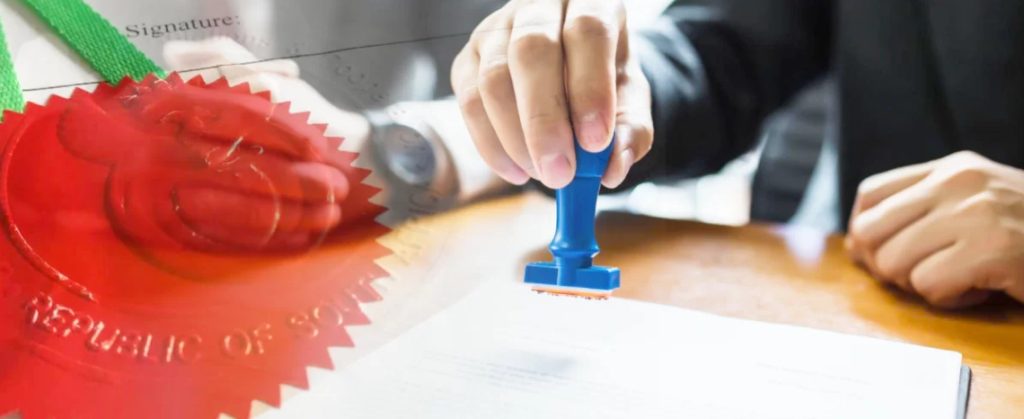
Affidavit Apostille Document Requirements
To ensure a successful High Court Apostille, the affidavit must be:
- Properly completed and signed in the presence of a Notary Public.
- Presented in good condition with all notarisation stamps and signatures clearly visible.
- Free from any alterations, foreign markings, or attachments that could compromise verification.
Affidavits submitted for apostille must be intended for use in jurisdictions that recognise the Hague Apostille Convention. If the receiving country is not a signatory, further legalisation via the relevant embassy may be required.
Frequently Asked Questions
- What is a High Court Apostille?
A High Court Apostille is an official certification affixed to a notarised document, confirming the authenticity of the Notary Public’s signature and seal. This allows affidavits to be recognised in countries that are members of the 1961 Hague Apostille Convention. - Why is notarisation required for affidavits?
Notarisation ensures that the affidavit is legally executed and authentic, providing foreign authorities with assurance of its validity. - Who issues High Court Apostilles in South Africa?
High Court Apostilles are issued by the South African High Courts upon submission of notarised documents. - Which countries recognise High Court Apostilles?
All countries that are signatories to the 1961 Hague Apostille Convention accept documents certified by the South African High Court. - How long does it take to obtain a High Court Apostille for an affidavit?
Typically, processing takes 1–3 working days after the affidavit has been notarised and submitted. - What is the cost of a High Court Apostille for an affidavit?
- High Court Apostille: R650 per affidavit
- Notary Public + Apostille: R1,200 per affidavit